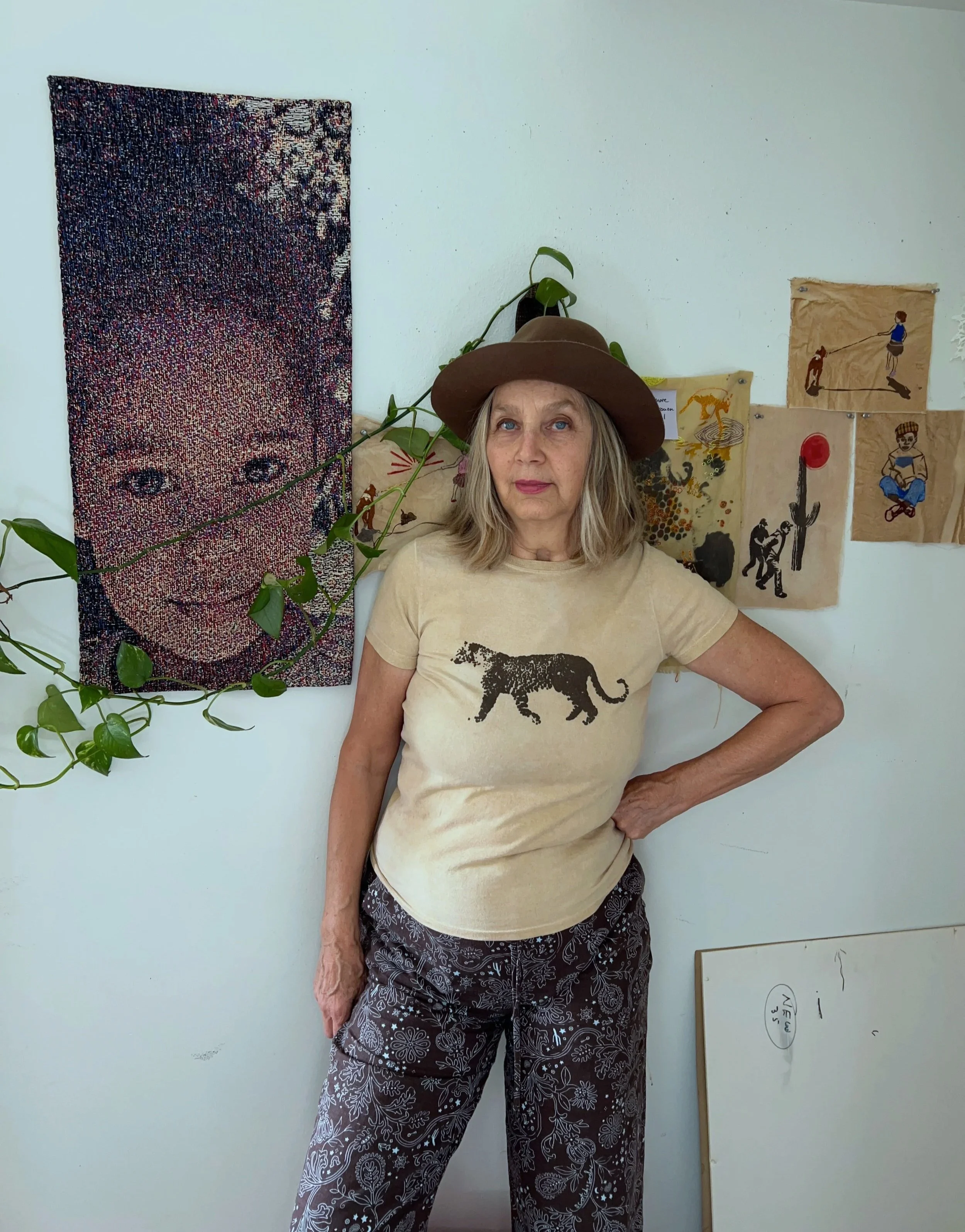
Born near Munich, Germany, Michaela Peters grew up within her family’s traditional hand-weaving business, a studio dedicated to weaving rugs from up-cycled textiles. Customers repurposed used clothing and sheets by cutting them into strips, then braiding, sewing, and crocheting them into weft material for rugs.
Trained in weaving through the traditional German guild system, she completed a rigorous apprenticeship at a studio specializing in folk costumes. Her graduation project received the "Best in Craft" distinction.
After working at a historic Jacquard weaving studio in the Bavarian Alps, she completed her Master Craftsman degree. In 1994, she moved to the U.S., where she earned her MFA in textiles from the California College of the Arts in 1996. She now moves between Germany and the United States, maintaining a weaving studio in Germany while continuing her multidisciplinary practice in California.
Her current research explores ancient dye processes, alongside contemporary recipes and resources. This work is deeply informed by the natural world—not just in the materials used, but in the living relationships between plant, animal, and the elements. Of special interest is the age-old process combining iron sulfate and tannic acid from oak galls or other tannin rich plants. By mixing the two, she creates a dye that shifts the fabric’s natural tannins into deep brown hues. Much like the iron in our blood makes stains so persistent, this iron-based dye forms a permanent bond with the fibers—a vivid reminder of our shared biology.
This connection to the body anchors her imagery, which evolves from a mix of personal and historical photography and found media. Converted into stencils and printed onto fabric, these images capture the passage of time like an insect trapped in amber—preserving special, fleeting moments. They mirror the inherent vulnerability of both the natural world and our own bodies against the backdrop of global conflict and environmental urgency.
She refers to these works as "memorial cloths," created to hold and honor specific places and memories. Each stitch serves as an act of preservation, binding memory into the structural grain of the fabric. Through this practice, art becomes both a necessity and a refuge: a means of protest, documentation, and healing.